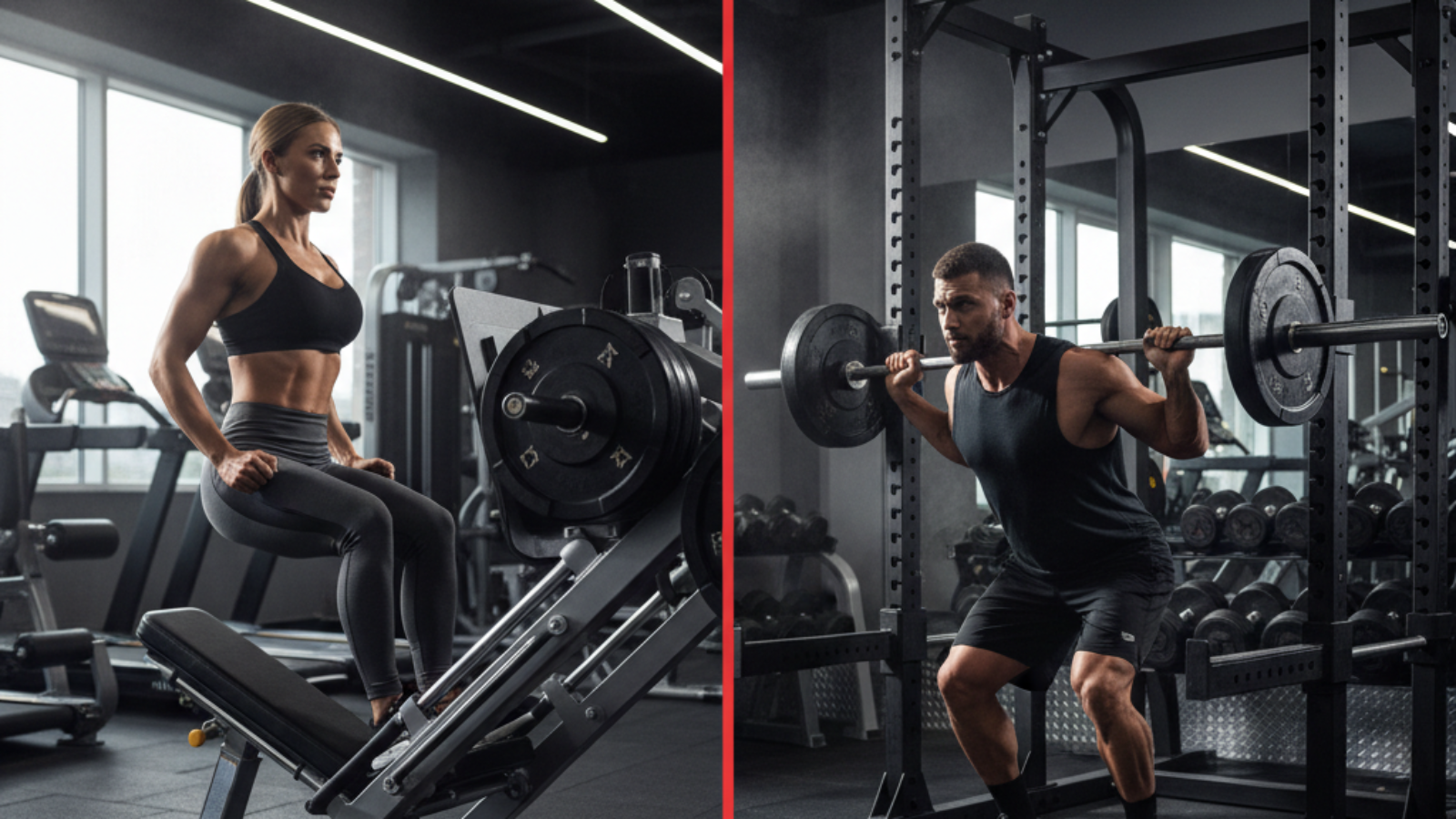
Understanding Leg Press vs Squat
What is the Leg Press? Proper Form and Key Benefits
The leg press is a strength training exercise using a machine. You sit on a seat and push a weighted platform away from your body with your feet. The leg press machine guides the movement, allowing you to control the load and keep your back protected. Main muscles used are the quadriceps, hamstrings, and glutes.
- Form: Seat yourself with your back and hips against the pad, feet shoulder-width apart on the platform. Push evenly and avoid locking knees.
- Benefits: Good for building leg strength and size. Offers a safe way to lift heavy without putting stress on your back. Great for beginners and people with back or balance issues.
What is the Squat? Proper Form and Key Benefits
The squat is a compound movement performed without a machine. It involves lowering your hips down and back, as if sitting in a chair, and standing back up. Squats use your quadriceps, glutes, hamstrings, back, and core.
- Form: Stand with feet shoulder-width apart. Keep your chest up and back straight. Lower down, bending knees, until your thighs are parallel to the floor or lower. Come back up by pushing through your heels.
- Benefits: Builds overall strength, improves balance and flexibility. It’s more functional because it mimics movements in sports and daily life. Squats also burn more energy and train your stabilizing muscles.
Summary Table: Quick Comparison of Leg Press vs Squat
| Aspect | Leg Press | Squat |
|---|---|---|
| Equipment Needed | Leg press machine | Barbell or bodyweight |
| Main Muscles Used | Quadriceps, glutes, hamstrings | Quadriceps, glutes, hamstrings, back, core |
| Stability | Stable, machine-guided | Requires core and balance |
| Skill Level | Beginner-friendly | Beginner to advanced |
| Injury Risk | Low for back | Can strain back/knees if done incorrectly |
| Functional Movement | No | Yes |
How to Perform the Leg Press and Squat Safely
Step-by-Step: Correct Leg Press Technique
- Sit on the leg press machine. Place your back and head against the seat pad. Put your feet shoulder-width apart on the platform, toes slightly out.
- Grip the handles for support. Release the safety levers if needed.
- Slowly lower the platform toward your chest by bending your knees. Keep your heels flat and back pressed against the pad.
- Stop when your knees are at about a 90-degree angle. Avoid letting your knees go inward or outward.
- Push the platform back up by straightening your legs. Do not lock your knees at the top.
- Repeat for the required number of reps, then lock the safety levers before leaving the machine.
Step-by-Step: Correct Squat Technique
- Stand with your feet a bit wider than shoulder-width. Toes should point slightly out.
- If you use a barbell, place it across your upper back, not on your neck. Hold the bar with hands slightly wider than shoulders.
- Breathe in. Tighten your core. Push your hips back while bending your knees. Lower yourself slowly, keeping your chest up and back neutral.
- Go down until thighs are parallel to the floor or a little lower if possible.
- Push through your heels to stand up. Exhale as you rise. Keep knees tracking over toes, not collapsing inward.
- Repeat the movement for your set. Always keep a steady pace and control the weight.
Common Mistakes and How to Avoid Them (for Both Exercises)
- Avoid letting your knees collapse inward or push out too far.
- Do not round your back; keep it straight and neutral.
- Do not lock your knees at the top of the movement.
- For leg press: Do not lower the platform too far, which can stress your lower back.
- For squats: Avoid leaning forward too much; keep your chest lifted and core tight.
- Warm up before starting and use proper weights for your fitness level.
Leg Press vs Squat: Which is Better for Your Fitness Goals?
Muscle Activation and Functional Differences
Both leg press and squat target the major leg muscles, but they activate them in different ways. The squat also challenges your core and back because you need to stabilize your body. Squats are more functional, helping with movements in sports and daily life. Leg presses are better for isolating leg muscles and focusing on muscle size and strength without working the core as much.
Strength, Hypertrophy, and Athletic Performance Considerations
- Strength: Both exercises improve leg strength. Squats activate more muscles at once.
- Hypertrophy (muscle growth): Both help muscle size, but adding weight safely is often easier with the leg press for beginners.
- Athletic Performance: Squats boost vertical jump, sprint speed, and overall power since they develop balance and coordination, while the leg press builds foundation strength.
Suitability for Beginners, Intermediates, and Advanced Lifters
- Beginners: Leg press is safer and provides guided movement. Bodyweight squats are also a good start.
- Intermediates: Combine both to target different muscle aspects and improve overall performance.
- Advanced: Squats are essential for athletic development. Advanced lifters use both exercises in training blocks for best results.
Programming Leg Press and Squat Into Your Workout Routine
How to Choose Based on Your Fitness Level and Goals
- If your goal is leg strength and size but you struggle with squat form, start with leg press.
- If athletic performance or functional movement is your aim, prioritize squats as soon as your form is safe.
- If recovering from a back injury, use the leg press until you are ready for squats again.
- Combine both for full development over time.
Sample Workout Plans for Different Objectives
- For Beginners:
- Leg Press: 3 sets of 10-12 reps
- Bodyweight Squat: 3 sets of 12-15 reps
- For Muscle Gain:
- Leg Press: 4 sets of 8-10 reps, increase weight gradually
- Barbell Squat: 4 sets of 6-8 reps
- For Strength and Performance:
- Barbell Squat: 5 sets of 5 reps
- Leg Press: 3 sets of 8-10 reps after squats
Combining Leg Press and Squat: When and Why
- Use both in the same leg workout to exhaust all leg muscles and break through plateaus.
- Squat first for power and technique, then do leg press to push your muscles further with less risk.
- Alternate between sessions to reduce joint stress.
Expert Tips for Maximizing Results
Pro Insights: When to Prioritize Each Movement
- Prioritize squats if you want athletic improvement or full-body involvement.
- Choose leg press during rehab, after injury, or when targeting muscle growth with minimal back strain.
- Use leg press if you want to increase volume safely before progressing to harder squat variations.
Addressing Plateaus: How to Progress Safely
- Increase weight gradually – 2.5 to 5 kg increments are enough.
- Change your rep range every few weeks (for example, move from 12 to 8 reps per set).
- Try new squat variations: front squat, box squat, or single-leg squat.
- Use different feet positions on the leg press to target different muscles.
- Track your progress and adjust your workouts monthly.
Injury Prevention and Recovery Tactics
- Warm up with light cardio and dynamic stretching before leg workouts.
- Use proper form and avoid lifting too much weight too soon.
- Rest for at least 48 hours between hard leg sessions.
- If you feel pain in your knees or back, quit the set and check your technique.
- Consult a professional if you have injuries or chronic pain before starting a new leg routine.
Real-World Scenarios: Case Studies and Athlete Examples
Weight Loss, Muscle Gain, and Injury Rehab Stories
- Weight Loss: A high school student used both squats and leg presses to burn calories and build leg muscle. Result: improved fitness test scores and better performance in sports.
- Muscle Gain: An intermediate lifter alternated heavy squats with light leg press sessions. Result: noticeable muscle growth and increased confidence in lifting more weight over three months.
- Injury Rehab: After a knee sprain, a soccer player started with light leg press because it kept the back safe. Over time, they added bodyweight squats and soon returned to full athletic activity with stronger legs.
FAQs Answered by Fitness Pros
- Can I only do leg press or squat? Both exercises have unique benefits. Combining them gives the best results for most people.
- Do I need a machine for strong legs? No, but machines like the leg press help you train safely and focus on the legs, especially for beginners.
- Which is best if I have back pain? The leg press is safer for most, but always check with a doctor first.
- How deep should I squat? Go as low as your flexibility and comfort allow, keeping your form correct.
Frequently Asked Questions: Leg Press vs Squat (2026 Update)
- Is leg press safer than squat? Yes, leg press puts less strain on your lower back, but squats build more functional strength.
- Which burns more calories: leg press or squat? Squats burn more because they use more muscles and energy.
- Do I need to choose one, or can I do both? Doing both leg press and squat is often best for balanced results.
- How do I know if my form is correct? Ask a coach to check, or record yourself for feedback. Proper form prevents injuries and gets you reliable results.
- How many times a week should I train legs? Two to three times a week is enough for most goals.
Summary: Key Points and Next Steps
- Both leg press and squat are excellent for building strong legs. Choose based on your goals, fitness level, and any injury concerns.
- Use proper form and warm up before training. Start with manageable weights and increase steadily.
- Combine both leg press and squat for best results, and don’t be afraid to ask questions or seek feedback.
- If you hit a plateau, change up reps, rest, or try new exercise variations.
- Focus on consistency and safety for the best long-term progress. Now, it’s time to set your goals and start training!