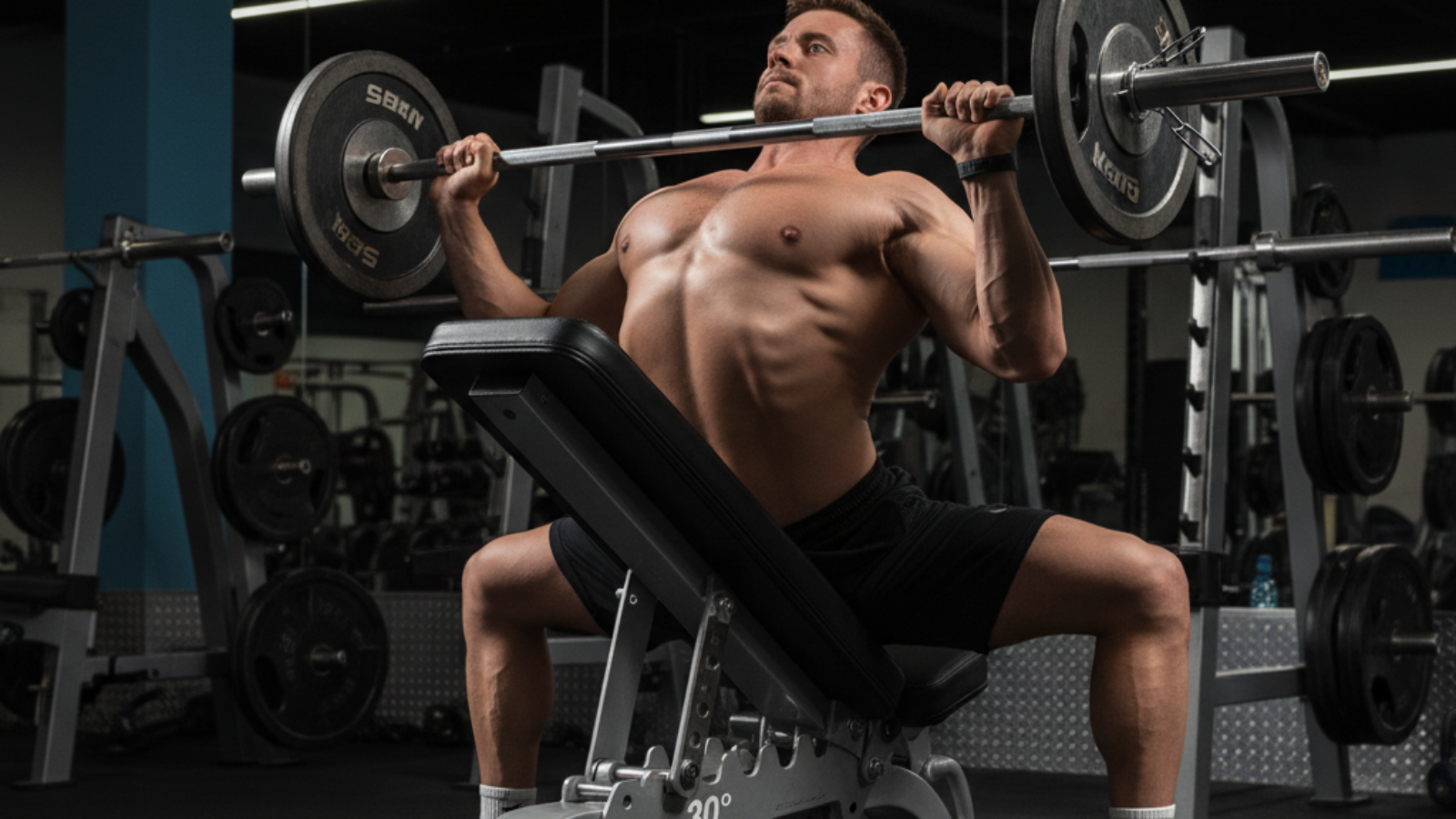
Understanding the Incline Bench Press Angle
What Is the Incline Bench Press and Why Angle Matters
The incline bench press is a popular exercise that targets your upper chest and shoulders. Unlike the flat bench press, you do this on a bench set at an angle. The angle is important because it changes which muscles work most. The right angle can help you build a stronger and more defined chest.
The Science – How Angle Influences Chest Muscle Activation
When you change the bench angle, the stress on your chest, shoulders, and triceps also changes. Higher angles activate more of your shoulders. Lower angles focus more on your chest. Experts use EMG (electromyography) studies to measure how hard your muscles are working at each angle. This helps us know which angle is best for your goals.
Anatomy 101 – Upper Chest, Shoulders & Personal Biomechanics
Your upper chest, called the clavicular head of the pectoralis major, is smaller than your middle chest. When you press at an incline, this muscle works harder. How your body is built—longer arms, torso length, or shoulder flexibility—can also affect how the angle feels and works for you.
What’s the Optimal Incline Bench Press Angle? (Based on Science in 2026)
Reviewing the Research: EMG Studies and Expert Opinions
Most new EMG research (up to 2026) agrees that an angle of 30 degrees gives your upper chest the most activation with less risk of shoulder pain. At 45 degrees, your shoulders take over. At 15 degrees, there is less upper chest work. Coaches and scientists agree: 30-degree incline is the “sweet spot” for most people.
Common Recommendations: 15°, 30°, or 45°?
- 15°: More like a flat bench press. Good for beginners.
- 30°: Best for upper chest growth. Most recommended.
- 45°: Shifts the work to your shoulders. Can strain them if you’re not careful.
Individual Differences: How Body Structure Affects Your Ideal Angle
Your body is unique. If you have long arms or shorter torso, a slightly lower or higher angle might feel better. Always start at 30 degrees and adjust based on comfort and chest activation, not pain.
How to Choose the Right Angle for Your Goals
Building Upper Chest Size and Definition
If you want a more defined upper chest, stick to an incline of about 30 degrees. Use slow reps and lighter weights to really feel your upper chest working. Focus on muscle squeeze, not just moving the weight.
Maximizing Strength vs. Muscle Growth (Hypertrophy)
- For strength: Use a moderate incline (15-30 degrees), heavier weights, and fewer reps (4-6).
- For muscle growth: Use 30 degrees, lighter to medium weights, and more reps (8-12), with full range of motion.
Sports-Specific Training: Athletes, Beginners, and Bodybuilders
- Athletes: Pick angles that match your sport’s needs. Football or rugby players may use higher angles to build powerful shoulders.
- Beginners: Start at lower angles to learn proper form and avoid injury.
- Bodybuilders: Switch angles over time. Start at 30 degrees, but try 15° and 45° every few weeks for more complete chest development.
Step-by-Step: Setting Up Your Incline Bench Press
Spotting the Correct Angle on Different Benches
- Look for the angle marks on your bench. Many benches have numbers or degree labels.
- If there are no marks, compare the bench back to a wall or use a phone app for measuring angles.
- Set it to about one-third of the way between flat and upright—this is usually 30 degrees.
Adjusting for Home Gym and Commercial Gym Equipment
- Home gyms: Use benches with adjustable backs. If uncertain, measure the angle with a protractor app.
- Commercial gyms: Look for incline benches that are fixed or have easy-to-read notches. Ask a staff member if you’re unsure.
Safety Tips and Essential Form Cues
- Always use a spotter if lifting heavy weights.
- Keep your feet flat on the floor and your back pressed lightly on the bench.
- Grip the bar slightly wider than shoulder-width.
- Lower the bar slowly to your upper chest (not your neck!).
- Press up while feeling your chest muscles, not just your arms.
Advanced Tips and Personalization
Fine-Tuning Grip, Elbow Path, and Tempo for Best Results
- Grip: Too wide targets shoulders, too narrow shifts focus to triceps. Aim for just wider than shoulders.
- Elbows: Let your elbows move at a 45-degree angle from your sides, not straight out.
- Tempo: Try lowering the bar in 2-3 seconds and pressing up in 1 second.
Troubleshooting Common Mistakes (Shoulder Pain, Limited Range, etc.)
- If you feel shoulder pain, lower the angle or lighten the weight.
- If you can’t go low enough, stretch your shoulders and chest before lifting.
- If you don’t feel your chest muscles, check your elbow and grip positions.
Programming the Incline Bench Press into Your Routine (Split Types, Frequency, Progression)
- Include incline bench press 1-2 times per week.
- If you use a full-body routine, one day can focus on incline. If you do “push/pull/legs,” use incline on your chest or push day.
- Increase weight or reps slowly. Add small weight increments every 1-2 weeks, or increase reps by one each week.
Frequently Asked Questions: Incline Bench Press Angle
Is 30 Degrees Always Best?
Not always, but it works for most people. Adjust up or down if your chest or shoulders feel uncomfortable. Listen to your body.
How Do I Know If My Chest (Not Shoulders) Is Working?
You should feel a squeeze across your upper chest as you press up. If you only feel your shoulders or arms, check your angle, grip, and elbow path.
Should I Vary Bench Angles Over Time?
Yes! Changing angles sometimes helps train all chest parts and avoids plateaus. Try a cycle: 4 weeks at 30°, then 2 weeks at 15° or 45°, then repeat.
Alternatives and Accessory Exercises
- Incline dumbbell press (use the same angles)
- Incline push-ups
- Cable incline flyes
- Machine incline press
Expert Insights and Pro Tips for 2026
Coach & Trainer Recommendations
- Start light until the form is perfect.
- Warm up your shoulders and upper chest before heavy sets.
- Use a spotter, especially when lifting near your maximum.
Real-World Case Studies and Athlete Examples
Many pro athletes and bodybuilders use incline bench at 30 degrees to shape their upper chest. They keep their form strict and adjust the angle a bit if they feel pain or discomfort.
The Latest Advancements in Equipment and Technique
New benches now include digital angle settings for accuracy. Some even have built-in sensors that track your reps and angle changes to help you improve faster.
Visual Guide: Demonstrating Incline Bench Angles (Step-by-Step Images & Quick Reference Chart)
Visuals can help a lot. Imagine looking at a chart comparing bench angles:
| Bench Angle | Main Muscles Worked | Best For |
|---|---|---|
| 15° | Middle & Upper Chest | Beginners, gentle on shoulders |
| 30° | Upper Chest | Muscle growth, most people |
| 45° | Upper Chest, Shoulders | Advanced, athletes needing shoulder power |
- Start with the bench flat (0°). Notice it hits mostly the middle chest.
- Raise the bench to 15°. There’s a small upper chest boost.
- At 30°, the upper chest is clearly more active.
- At 45°, your shoulders do more work—stop if they hurt!
Summary: Key Takeaways and Next Steps
The incline bench press is powerful for building your upper chest. Most people get the best results at 30 degrees. Always focus on form and muscle feeling, use the right tools and spotter, and progress slowly. Try different angles over time, and watch your chest get stronger and more defined.
Ready to improve your workout? Set your bench, use our safety tips, and experiment to find your favorite angle. Stay consistent and track your results for the best upper chest gains!