
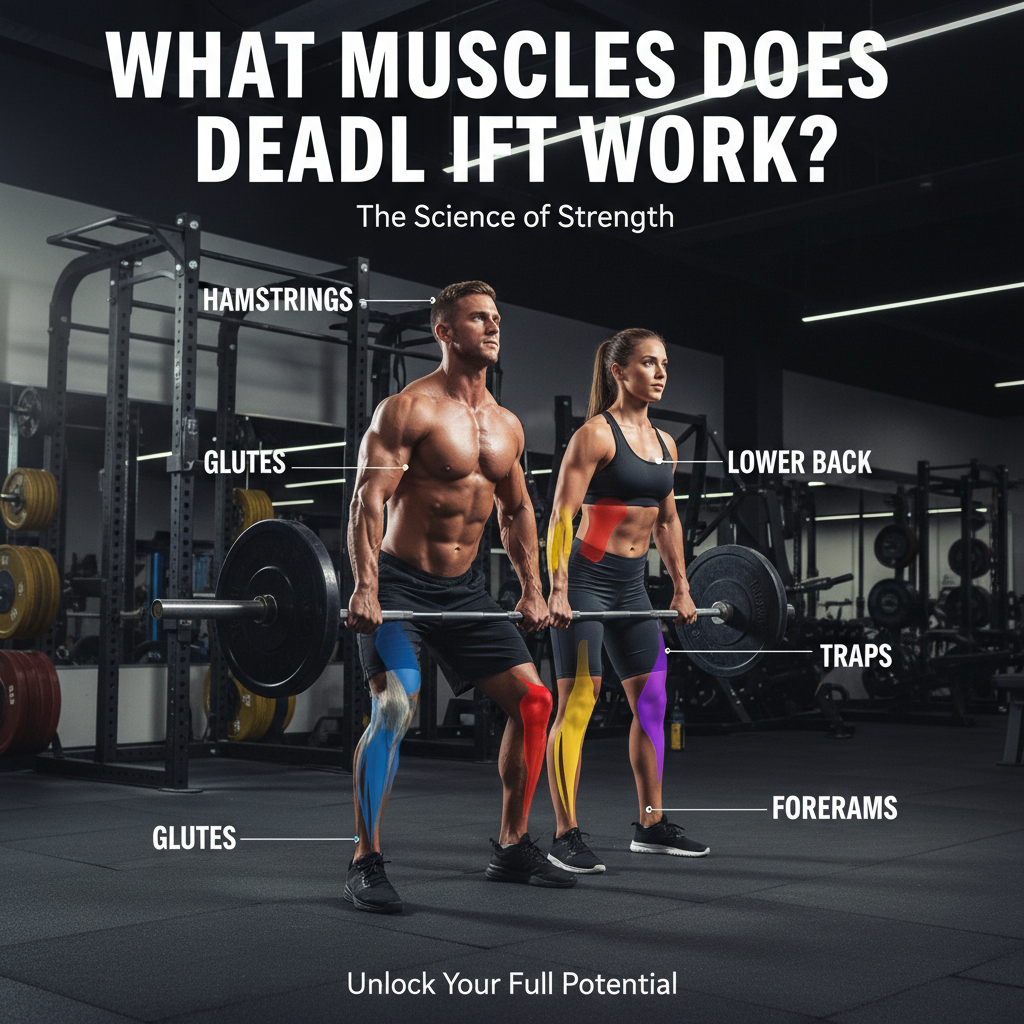
The deadlift is a fundamental weightlifting exercise known for its compound movement. It involves lifting a loaded barbell from the ground to hip level using multiple muscle groups. Unlike isolation exercises, deadlifts simultaneously target various areas of the upper and lower body, providing efficient overall development.
Knowing which muscles the deadlift works is crucial for optimizing performance and preventing injury. Muscle activation insight helps tailor programming for specific goals such as strength, hypertrophy, or rehabilitation. It also aids in improving technique and maximizing results.
The gluteus maximus is the prime mover during deadlifts. Its primary function is hip extension, crucial for locking out the weight at the top of the lift. Research shows glute activation approaches 80-120% of maximum voluntary contraction depending on load and stance, making deadlifts optimal for glute strength and hypertrophy (Schoenfeld, 2010).
The hamstrings support hip extension and stabilize the knee joint during deadlifts. Surface EMG studies report significant hamstring engagement, particularly in the Romanian and stiff-legged variations. Deadlifts improve both functional strength and injury resilience in the posterior thigh.
The erector spinae runs along your back and plays a pivotal role in spinal stabilization during deadlifts. These muscles resist spinal flexion, maintaining neutral alignment under load. EMG data indicate deadlifts activate the erectors up to 85% of their maximal contraction, making them essential for lower back strength (Escamilla, 2001).
Deadlifts require scapular retraction and depression, engaging the traps and rhomboids. Lats also act as stabilizers, creating tension and controlling the bar path. Studies show upper trapezius activation exceeds 50% maximal during maximal pulls, highlighting the lift’s comprehensive back benefits.
While not a primary mover, the core is vital in deadlifts. Deep core muscles (transverse abdominis, obliques) create intra-abdominal pressure, protecting the spine. Proper bracing can generate up to 3x bodyweight in spinal support forces, key for heavy lifting safety and effectiveness.
Deadlifting trains grip strength as you hold the bar throughout the lift. Forearm flexors maintain control, receiving a high isometric workload, especially in heavy or high-rep sets. Enhanced grip translates to better performance in other strength movements.