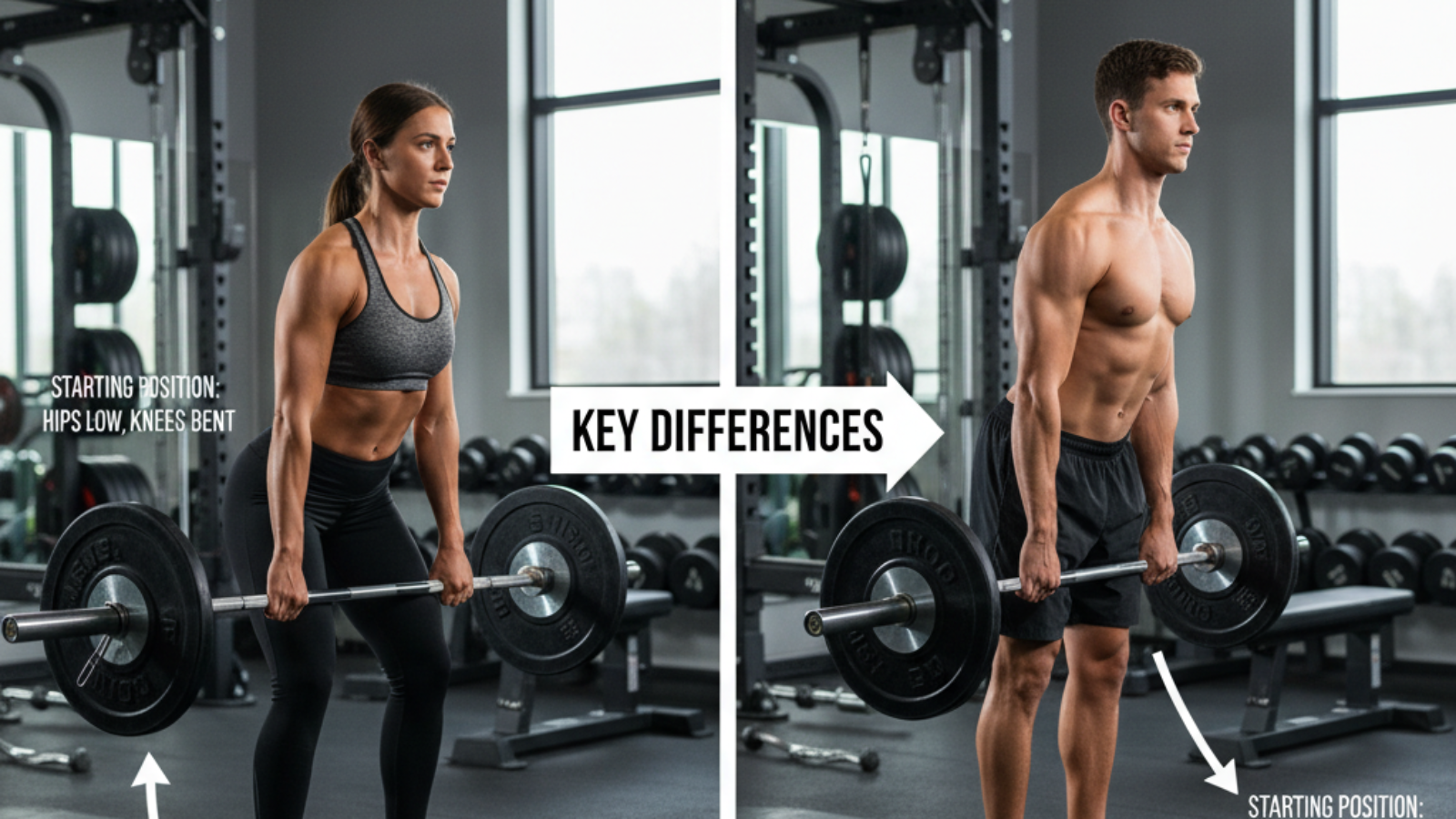
Deadlift vs RDL Quick Comparison Table
Summary of Key Differences
| Aspect | Deadlift | Romanian Deadlift (RDL) |
|---|---|---|
| Primary Focus | Total-body strength, maximal lifting | Posterior chain isolation, hamstrings & glutes |
| Range of Motion | Ground to lockout | Hip hinge, bar stops just below knees/shins |
| Main Muscles | Glutes, hamstrings, back, traps, grip | Hamstrings, glutes, lower back |
| Starting Position | From floor, hips lower | Top down, hips higher, soft knees |
| Load Used | Highest possible, often 1RM tested | Lighter, strict form, moderate reps |
| Goal Suitability | Strength, powerlifting, overall mass | Hamstring hypertrophy, athletic training |
Which Is Best for Your Goal?
- Strength and Power: Deadlift
- Hamstring & Glute Focus: RDL
- Injury Prevention: RDL (safer for lower back at lighter weights)
Understanding the Basics: What Are Deadlifts and RDLs?
Conventional Deadlift Explained
The deadlift is a compound movement where lifters pull a loaded barbell from the floor to a standing position. It engages virtually every major muscle group and builds full-body strength. This lift is a staple in powerlifting, strength training, and general fitness programs.
Romanian Deadlift (RDL) Explained
The Romanian deadlift (RDL) is a hip-hinge movement starting from a standing position. The lifter lowers the barbell by hinging the hips back while keeping a slight knee bend. The RDL focuses on the posterior chain—especially the hamstrings and glutes—and is valued for hypertrophy and injury resilience.
Technique Deep Dive: How to Perform Each Lift Safely
Step-by-Step Deadlift Form Guide
- Stand with feet hip-width apart, bar over mid-foot.
- Grip the bar just outside knees, bend knees until shins touch bar.
- Brace core, flatten back, and pull chest up.
- Push through heels and extend hips and knees to stand up straight.
- Reverse the motion to lower the bar to the floor under control.
Step-by-Step RDL Form Guide
- Start standing, holding bar at thigh-level, feet hip-width apart.
- Maintain soft knees. Hinge hips back, keeping bar close to legs.
- Lower until you feel a stretch in hamstrings; bar just below knees.
- Do not allow the back to round. Keep core engaged.
- Drive hips forward to return to standing position.
Video Demonstrations and Cues (with Updated 2026 Best Practices)
- Look for 2026 updated video guides emphasizing neutral spine, controlled eccentrics, and grip variations for both lifts.
- For trusted demos, see Rogue Fitness Deadlift Tutorial and Stronger By Science RDL Guide.
Muscles Targeted: Deadlift vs RDL Breakdown
Posterior Chain Activation and EMG Insights (2024-2026 Research)
Recent EMG studies (2024-2026) show deadlifts elicit higher overall muscle activation, especially in lumbar erectors and upper back muscles. RDLs, however, produce greater normalized hamstring activation (up to 15% more than conventional deadlift at moderate loads), making them ideal for posterior chain hypertrophy.
Glute, Hamstring, and Lower Back Involvement
- Deadlift: Glutes, hamstrings, lower back, mid-upper back, grip heavily involved.
- RDL: Maximal tension on hamstrings and glutes, less direct lower back loading.
Hypertrophy vs Strength Outcomes
- Deadlift: Prioritizes full-body strength increases; hypertrophy as secondary effect.
- RDL: Prioritizes muscle growth in hamstrings and glutes with moderate weights/reps.
Which Lift Should You Choose? Use Cases and Programming
Deadlift vs RDL for Powerlifters, Athletes, and Hybrid Training
- Powerlifters: Deadlifts are essential for competition strength.
- Athletes: RDLs favored for explosive posterior chain development and injury prevention.
- Hybrid training: Combining both provides robust strength and muscle balance.
Recommendations for Women, Beginners, and Older Lifters (2026 Update)
- Women: RDLs support glute development and core stability; deadlifts boost strength.
- Beginners: RDLs teach safe hip hinging before progressing to deadlifts.
- Older Lifters: RDLs put less spinal stress, offering a safer path to posterior chain health.
Application in Injury Prevention and Rehab Protocols
- RDLs are commonly used in hamstring rehab and back health protocols due to controlled loading and limited range of motion.
- Deadlifts can build general resilience if performed with perfect form.
Common Mistakes and How to Avoid Them
Deadlift Pitfalls and Fixes
- Rounded lower back – Fix: Brace core, maintain neutral spine.
- Bar too far from shins – Fix: Start with bar over mid-foot.
- Jerking the weight – Fix: Pull slack from bar, drive through heels.
RDL Pitfalls and Fixes
- Excess knee bend – Fix: Keep a slight bend, no squatting.
- Bar drifting away – Fix: Keep bar close to thighs/shins throughout.
- Hyperextending or rounding back – Fix: Strong core, controlled range.
Programming Deadlifts and RDLs in 2026: Modern Split and Hybrid Training Advice
Weekly Schedules and Progression for Strength, Hypertrophy, and Performance
- Strength Focus: Deadlifts 1x/week, heavy sets (3-5 reps); RDLs 1-2x/week, moderate reps (6-10).
- Hypertrophy: RDLs 2x/week, higher reps (8-12); Deadlifts 1x/week, moderate load.
- Performance: Alternate both lifts in push/pull or lower-body splits.
Accessory Lifts and Synergies
- Add hip thrusts, leg curls, and single-leg RDLs for balance and injury prevention.
- Chin-ups, rows, and core work boost deadlift carryover.
Expert Tips, Myths, and FAQs: Insights from Top Coaches (2026 Edition)
Recent Science and Coach Interviews
Leading coaches agree: Proper hinge mechanics and progressive overload in both lifts deliver results. New studies highlight the efficiency of RDLs for targeted hamstring strength, with minimal lumbar strain when done right.
Myths Debunked (e.g., RDLs and Back Safety)
- Myth: RDLs are dangerous for your back.
- Fact: RDLs performed with proper form and manageable loads are safer for the lower back than heavy deadlifts, especially in high-volume routines.
Frequently Asked Questions
- Can I do both lifts in one week? Yes, with good recovery.
- Which is better for fat loss? Both, if programmed with a calorie deficit.
- Do I need special equipment? Standard barbell and plates; straps or belts optional.
Conclusion: Choosing the Right Lift for Your Fitness Journey
Both the deadlift and RDL are essential lifts with unique advantages. Deadlifts build total-body strength and athletic power; RDLs focus on hamstring and glute development with safer mechanics. Your goal, experience, and injury history dictate the best choice. Integrate both for balanced results.
- For Deadlift & RDL equipment, check out the latest deals at Rogue Fitness Barbells or Amazon Deadlift Gear.
- Ready to take your strength further? Start programming both lifts now!