How Many Exercises Per Workout
A practical step-by-step guide to how many exercises per workout, including preparation, instructions, common issues, tips, and next steps.
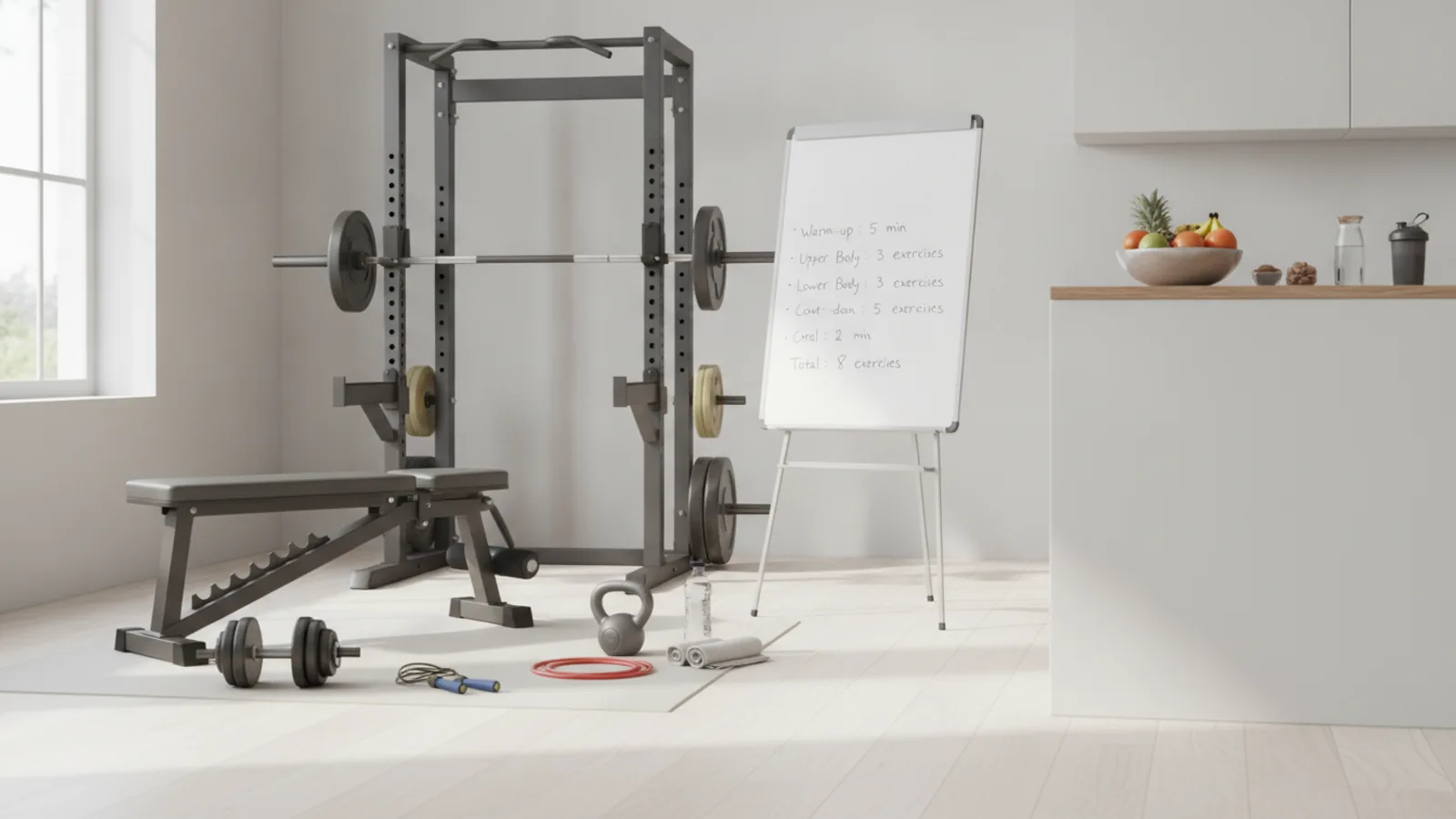
How Many Exercises Per Workout
Deciding how many exercises to do per workout can feel confusing, but it doesn't have to be. The right number depends entirely on your personal goals, how much time you have, and your current fitness level. This guide provides clear, practical steps to help you build a structured and effective workout plan, whether you're aiming for strength, muscle growth, or general fitness. We'll help you move past guesswork and focus on what truly delivers results.
Fast Answer
- General Guideline: For most goals, aim for 5-8 exercises per workout.
- Beginners: Start with 4-6 exercises in a full-body routine.
- Key Factor: Total weekly sets per muscle group matter more than the number of exercises.
Before You Start
Planning is key to an effective workout. Before you choose your exercises, make sure you have a clear understanding of your goals and limitations. This preparation ensures your workout is both safe and tailored to you.
What You Need
- Clear Fitness Goals: Know what you want to achieve. Are you training for strength, muscle size (hypertrophy), endurance, or general health?
- A Realistic Schedule: Decide how many days per week you can consistently commit to exercising.
- Access to Equipment: Know what you have available, whether it's a full gym, a few dumbbells at home, or just your own bodyweight.
- A Way to Track Progress: Use a simple notebook, a spreadsheet, or a fitness app to log your workouts. This is crucial for making progress.
Safety, Timing, and Context Checks
- Form Over Quantity: Performing 5 exercises with excellent form is far better than doing 10 with poor form. Bad form leads to injury, not results.
- Listen to Your Body: Soreness is normal, but sharp pain is not. Don't be afraid to take an extra rest day if you feel overly fatigued or run down.
- Warm-ups and Cool-downs: Always dedicate 5-10 minutes to a dynamic warm-up before your workout and a cool-down with stretching afterwards.
How to Determine the Right Number of Exercises
Follow these steps to build a workout plan with the optimal number of exercises for your specific situation. This structured approach helps eliminate "junk volume"—exercises that just add fatigue without contributing to your goals.
Define Your Primary Fitness Goal
Your main objective is the single most important factor in deciding how many exercises to do. Different goals require different training styles and volumes.
- Strength: The goal is to lift as much weight as possible. This requires focusing on heavy, compound movements. A typical strength workout will have fewer exercises (3-5), with more sets and longer rest periods (3-5 minutes) to allow for maximum recovery.
- Hypertrophy (Muscle Growth): The goal is to increase muscle size. This involves creating metabolic stress and muscle damage. Workouts usually have more exercises (5-8), mixing compound and isolation movements with moderate weight and shorter rest periods (60-90 seconds).
- Muscular Endurance: The goal is to perform an exercise for a high number of repetitions. This often involves circuit training with many exercises (6-10+), lighter weights or bodyweight, and very little rest between them.
- General Fitness: The goal is a balanced mix of strength, endurance, and overall health. A full-body routine with 4-6 exercises covering major movement patterns is a great starting point.
Choose Your Workout Split
Your "split" is how you organise your training week. It determines which muscles you work on which days, and directly influences how many exercises you'll do in a single session.
- Full Body (2-3 days/week): You train every major muscle group in each workout. Because you're hitting everything, you'll do fewer exercises per session, typically 4-6 exercises. This is ideal for beginners or those with limited time.
- Upper/Lower Split (4 days/week): You split your workouts into upper body days and lower body days. This allows you to focus more on specific muscle groups, so you'll do more exercises per session, around 6-8 exercises.
- Push/Pull/Legs (PPL) Split (3-6 days/week): This popular split groups muscles by their movement pattern: 'push' muscles (chest, shoulders, triceps), 'pull' muscles (back, biceps), and legs. Each workout can contain 5-7 exercises focused on that specific group.
Prioritise Compound Exercises
No matter your goal, your workout should be built around compound exercises. These are multi-joint movements that work several muscle groups at once. They are highly efficient and give you the most return on your time investment.
Start every workout with 2-3 compound exercises. This is where you should focus most of your energy.
Key Compound Exercises by Muscle Group:
- Legs: Squats, Deadlifts, Lunges, Leg Press
- Chest: Bench Press (flat, incline, dumbbell), Dips
- Back: Pull-ups, Bent-over Rows, T-Bar Rows
- Shoulders: Overhead Press (barbell or dumbbell)
Add Isolation (Accessory) Exercises
After your main compound lifts, you can add isolation exercises. These movements target a single muscle group and are great for addressing weaknesses, improving muscle definition, and adding extra training volume without causing too much systemic fatigue.
Add 2-4 isolation exercises to your workout after you've completed your compound lifts. The specific exercises should support your main goal.
Examples of Isolation Exercises:
- Arms: Bicep Curls, Tricep Pushdowns, Skull Crushers
- Shoulders: Lateral Raises, Front Raises, Face Pulls
- Legs: Leg Extensions, Hamstring Curls, Calf Raises
- Back: Dumbbell Pullovers, Straight-Arm Pulldowns
Plan Your Total Weekly Volume
Fitness experts agree that the total number of hard sets you perform for a muscle group each week is a key driver of growth. The number of exercises is just a way to organise that volume.
A good evidence-based target for most people is 10-20 total sets per muscle group per week. You can reach this target with different combinations of exercises.
Example: 12 Sets for Chest in One Workout
- Option A (Fewer Exercises): Bench Press (5 sets), Incline Dumbbell Press (4 sets), Dips (3 sets). Total = 3 exercises, 12 sets.
- Option B (More Exercises): Bench Press (3 sets), Incline Dumbbell Press (3 sets), Cable Flys (3 sets), Push-ups (3 sets). Total = 4 exercises, 12 sets.
Both options achieve the same volume. Option A is better for strength, while Option B might be better for hypertrophy as it hits the muscle from more angles.
Be Realistic About Your Time and Energy
Finally, the best workout plan is the one you can stick to consistently. It's better to complete a 45-minute workout with high intensity and great form than to drag yourself through a 90-minute session with sloppy reps.
If you only have 45 minutes, a full-body workout with 4-5 compound exercises might be perfect. If you have 75 minutes, you have more time to follow an upper/lower or PPL split with 6-8 exercises. Factor in your warm-up, cool-down, and rest periods when planning your session length.
Quick Reference
| Primary Goal | Exercises Per Workout | Focus |
|---|---|---|
| Strength Building | 3-5 | Heavy compound lifts with long rest periods (3-5 mins). |
| Muscle Growth (Hypertrophy) | 5-8 | A mix of compound and isolation exercises with moderate rest (60-90 secs). |
| Muscular Endurance | 6-10+ | Circuits, bodyweight exercises, and very short rest periods (<30 secs). |
| General Fitness (Beginner) | 4-6 | Full-body routines focusing on one exercise per major movement pattern. |
Common Problems and Fixes
| Problem: "I'm working out consistently but not seeing results." |
Fix: The issue might not be the number of exercises, but a lack of progressive overload. To continue making progress, you must consistently challenge your muscles by increasing the weight, doing more reps or sets, or reducing rest time. Simply doing the same 8 exercises with the same weight for months won't lead to change. Also, review your nutrition and sleep, as they are critical for recovery and growth. |
|---|---|
| Problem: "I feel constantly tired, sore, and unmotivated to train." |
Fix: You may be doing too much volume, a condition known as overtraining. More is not always better. Try reducing the number of exercises per workout or the total number of sets. Ensure you are taking at least 1-2 complete rest days per week. It's better to be 10% undertrained than 1% overtrained. |
| Problem: "My workouts are taking too long." |
Fix: To make your workouts more time-efficient, prioritise compound movements as they work multiple muscles at once. You can also try implementing supersets—performing two exercises for opposing muscle groups (like a bicep curl and a tricep extension) back-to-back with no rest. This increases workout density and can significantly cut down on your time in the gym. |
Advanced Tips
- Use Periodisation: Instead of doing the same number of exercises and sets year-round, structure your training in cycles (or "blocks"). You could have a 4-week "volume" block with more exercises and sets, followed by a 4-week "strength" block with fewer exercises and heavier weight. This helps prevent plateaus.
- Focus on Mind-Muscle Connection: For hypertrophy-focused (muscle growth) accessory movements, slow down the repetition. Instead of just moving the weight, concentrate on feeling the target muscle contract and stretch. This can make 3 high-quality sets feel more effective than 5 rushed sets.
- Incorporate Deload Weeks: Every 4-8 weeks of hard training, plan a "deload" week. During this week, you can reduce the number of exercises, cut your total sets in half, or use much lighter weight. This allows your body and central nervous system to fully recover, setting you up for future progress.
How Many Exercises Per Workout FAQ
How many exercises should I do for a full-body workout?
For a full-body workout, aim for 4 to 6 exercises. The key is to select one exercise for each major human movement pattern: a squat (e.g., Goblet Squat), a hinge (e.g., Romanian Deadlift), a horizontal push (e.g., Dumbbell Bench Press), a horizontal pull (e.g., Bent-Over Row), and a vertical push (e.g., Overhead Press). This approach ensures you're training your entire body in a balanced way.
Is it better to do more exercises or more sets?
The total number of challenging sets per muscle group per week is the most critical metric for muscle growth. You can achieve this weekly volume with either more exercises and fewer sets per exercise, or fewer exercises and more sets per exercise. For beginners, it's often better to master fewer exercises with more sets to perfect your form before adding complexity.
How many exercises should I do for my abs?
Your abdominal muscles are heavily engaged during big compound lifts like squats, deadlifts, and overhead presses. For most people, adding 1-2 dedicated ab exercises (like leg raises or cable crunches) for 2-3 sets at the end of your workout, 2-3 times per week, is more than sufficient.
Can I just do one exercise per day?
Yes, this is a minimalist training style that can be effective, particularly for pure strength goals. For example, focusing only on the squat on one day and the bench press on another. However, for overall muscle development and a well-rounded physique, this approach is not optimal as it lacks the variety and volume needed to stimulate all muscle groups effectively.
Final Checklist for Planning Your Workout
- My primary fitness goal (strength, hypertrophy, etc.) is clearly defined.
- I have chosen a realistic workout split that fits my weekly schedule.
- My workout plan is built around 2-3 core compound exercises.
- I have added 2-4 isolation exercises that support my goals.
- My total number of exercises fits within my available workout time (typically 45-75 minutes).
- I am committed to prioritising excellent form and progressive overload over simply adding more exercises.
- I have a plan to track my workouts to ensure I am making consistent progress.