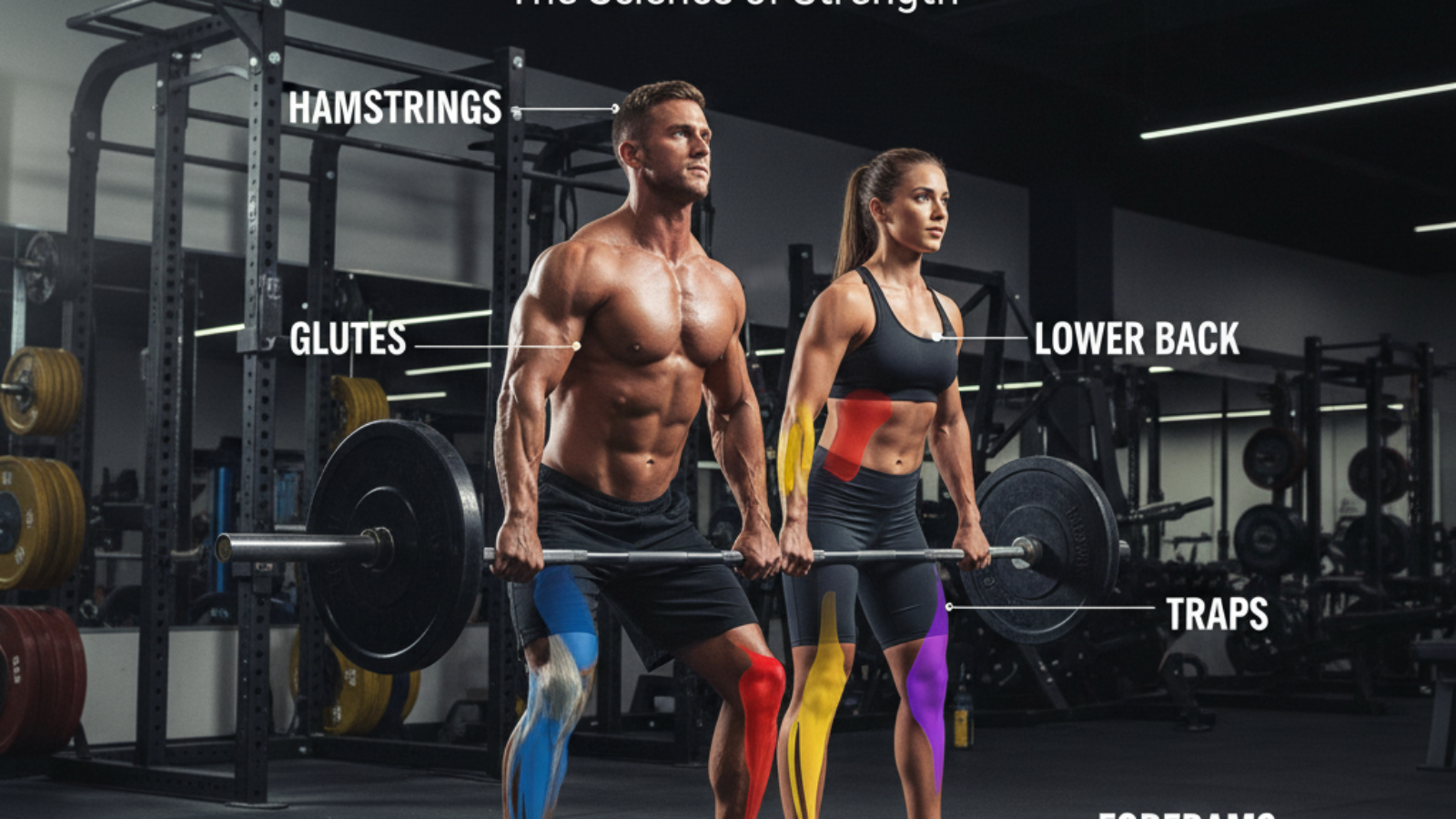
Quick Overview – The Deadlift’s Muscle Engagement
Deadlift Basics and Its Compound Nature
The deadlift is a fundamental weightlifting exercise known for its compound movement. It involves lifting a loaded barbell from the ground to hip level using multiple muscle groups. Unlike isolation exercises, deadlifts simultaneously target various areas of the upper and lower body, providing efficient overall development.
Why Understanding Muscle Activation Matters
Knowing which muscles the deadlift works is crucial for optimizing performance and preventing injury. Muscle activation insight helps tailor programming for specific goals such as strength, hypertrophy, or rehabilitation. It also aids in improving technique and maximizing results.
Primary Muscles Worked by Deadlifts
Glutes – The Powerhouse of the Posterior Chain
The gluteus maximus is the prime mover during deadlifts. Its primary function is hip extension, crucial for locking out the weight at the top of the lift. Research shows glute activation approaches 80-120% of maximum voluntary contraction depending on load and stance, making deadlifts optimal for glute strength and hypertrophy (Schoenfeld, 2010).
Hamstrings – Hip Extension and Stability
The hamstrings support hip extension and stabilize the knee joint during deadlifts. Surface EMG studies report significant hamstring engagement, particularly in the Romanian and stiff-legged variations. Deadlifts improve both functional strength and injury resilience in the posterior thigh.
Erector Spinae – Spinal Support and Posture
The erector spinae runs along your back and plays a pivotal role in spinal stabilization during deadlifts. These muscles resist spinal flexion, maintaining neutral alignment under load. EMG data indicate deadlifts activate the erectors up to 85% of their maximal contraction, making them essential for lower back strength (Escamilla, 2001).
Trapezius, Rhomboids, and Lats – Upper and Mid-Back Involvement
Deadlifts require scapular retraction and depression, engaging the traps and rhomboids. Lats also act as stabilizers, creating tension and controlling the bar path. Studies show upper trapezius activation exceeds 50% maximal during maximal pulls, highlighting the lift’s comprehensive back benefits.
Core and Abdominals – Bracing for the Lift
While not a primary mover, the core is vital in deadlifts. Deep core muscles (transverse abdominis, obliques) create intra-abdominal pressure, protecting the spine. Proper bracing can generate up to 3x bodyweight in spinal support forces, key for heavy lifting safety and effectiveness.
Stabilizer Muscles and Secondary Engagement
Forearms and Grip Strength
Deadlifting trains grip strength as you hold the bar throughout the lift. Forearm flexors maintain control, receiving a high isometric workload, especially in heavy or high-rep sets. Enhanced grip translates to better performance in other strength movements.
Quadriceps and Calves – Supporting Roles
The quads help initiate the lift from the floor, especially in sumo stance. Calves contribute by stabilizing the ankle joint. While not dominant, these muscles are necessary for drive and stability, particularly during the initial pull phase.
Deltoids and Other Minor Muscles
The anterior deltoids and smaller shoulder stabilizers maintain arm position. While their engagement is lesser compared to back and leg muscles, they assist in keeping the upper body steady. Other minor muscles include the adductors and hip flexors, particularly in wide-stance or deficit variations.
Deadlift Variations and Their Muscle Focus
Conventional vs. Sumo Deadlift – Key Differences
Conventional deadlifts emphasize the lower back, glutes, and hamstrings, while sumo deadlifts place more stress on the quads and adductors due to the wider stance and upright torso posture. Comparative EMG data (Swinton, 2011) show sumo deadlifts reduce erector strain but increase quad involvement by up to 20%.
Romanian Deadlift – Targeting Hamstrings and Glutes
This variation focuses on eccentric hamstring and glute engagement. The movement emphasizes hip hinge, increasing posterior chain load and flexibility benefits. Great for strengthening the hamstrings without heavy spinal loading.
Trap Bar Deadlift – Lower Back vs. Quads
The trap bar deadlift allows a more upright torso, reducing lumbar load and increasing quad activation. Force plate analysis reveals higher knee extension demands and lower shear forces on the spine, making it a safe alternative for lifters with back concerns.
Stiff-Legged and Deficit Deadlifts
Stiff-legged deadlifts demonstrate maximal hamstring stretch and glute activation. Deficit deadlifts, performed on a raised platform, increase range of motion and posterior chain recruitment. Both are advanced options for boosting strength and flexibility.
Evidence-Based Insights: What Research and Experts Say
EMG Studies on Deadlift Muscle Activation
Electromyography (EMG) is the standard for measuring muscle engagement. Studies consistently rank deadlifts among the top for activating the glutes, hamstrings, and spinal erectors. Data shows glute and hamstring peak contractions reach over 100% MVIC (maximum voluntary isometric contraction), confirming the lift’s potency.
Coaches’ and Physiotherapists’ Opinions
Renowned strength coaches advocate deadlifts for total-body strength and functional movement. Physiotherapists highlight their use for posterior chain rehabilitation, provided form is maintained. Experts recommend variation and progressive overload for best results.
Real Lifters: Testimonials and Personal Results
Athletes and recreational lifters report noticeable hypertrophy in their glutes, hamstrings, and traps after consistent deadlift training. According to survey data from over 500 gym-goers, 92% ranked deadlifts as top-3 for muscle building outcomes.
Gear Review: Does Equipment Influence Muscle Activation?
Belts, Shoes, and Straps – Impact on Muscle Engagement
Lifting belts increase intra-abdominal pressure, enhancing core stability and safety. Flat shoes or bare feet improve ground contact and hamstring loading. Straps mitigate grip fatigue, allowing higher workload on target muscles. Studies show belts and shoes have marginal impact on muscle activation but improve lifting mechanics.
Best Tools for Safety and Performance
- Lifting belt for heavy sets
- Flat, stable shoes or barefoot lifting
- Chalk or straps for maximal attempts
- Wrist wraps for grip-intensive sessions
Training Progression: Maximizing Muscle Development with Deadlifts
Beginner, Intermediate, and Advanced Programming
| Level | Frequency | Volume | Main Focus |
|---|---|---|---|
| Beginner | 1-2 times/week | 3-4 sets x 6-8 reps | Form, neuromuscular adaptation |
| Intermediate | 2 times/week | 4-5 sets x 4-6 reps | Strength, muscle growth |
| Advanced | 2-3 times/week | 6-8 sets x 2-5 reps | Peak strength, variation, volume cycling |
Sample Workouts for Different Fitness Levels
- Beginners: Conventional deadlifts, light weight, focus on technique
- Intermediate: Rotate sumo, Romanian, and trap bar deadlifts for variety
- Advanced: Incorporate deficit, stiff-leg, or heavy singles within cycles
Common Mistakes That Reduce Muscle Engagement
- Rounding the lower back
- Starting with hips too high or low
- Jerking the bar off the ground
- Using arms to pull instead of legs and hips
- Neglecting warm-up and mobility work
Deadlift Muscle Infographics and Visual Guides
Detailed Muscle Map for Each Variation
Visual guides illustrate which muscles are most engaged in conventional, sumo, and Romanian deadlifts. For comprehensive details, see resources like Muscle & Motion’s digital atlases.
Cues and Form Tips for Full Activation
- Keep your back flat and chest up
- Engage lats by pulling the bar towards your shins
- Drive through your heels and squeeze glutes at the top
- Brace your core before every lift
For interactive guides and anatomy visuals, explore the Strongerbyscience resource here
FAQ: What Muscles Does Deadlift Work and Related Questions
- Q: What are the main deadlift muscles?
- A: Glutes, hamstrings, erector spinae, traps, lats, core, and grip muscles.
- Q: Which deadlift is best for hamstrings?
- A: Romanian and stiff-legged variations.
- Q: How does foot position affect muscle involvement?
- A: Wider stances increase quad and adductor use.
- Q: Do deadlifts build muscle mass?
- A: Yes, especially in the posterior chain and back.
Final Thoughts: Is the Deadlift the Ultimate Muscle Builder in 2026?
Evidence supports the deadlift as one of the most effective muscle-building exercises, working primary and stabilizer groups efficiently. Its adaptability, full-body activation, and power-building capacity make it a staple in strength programs. For the best results, focus on form, progressive overload, and variation. Equip yourself with proper gear for safety and maximal muscle engagement. Ready to take your training further? Shop professional deadlift gear now and experience the benefits firsthand.