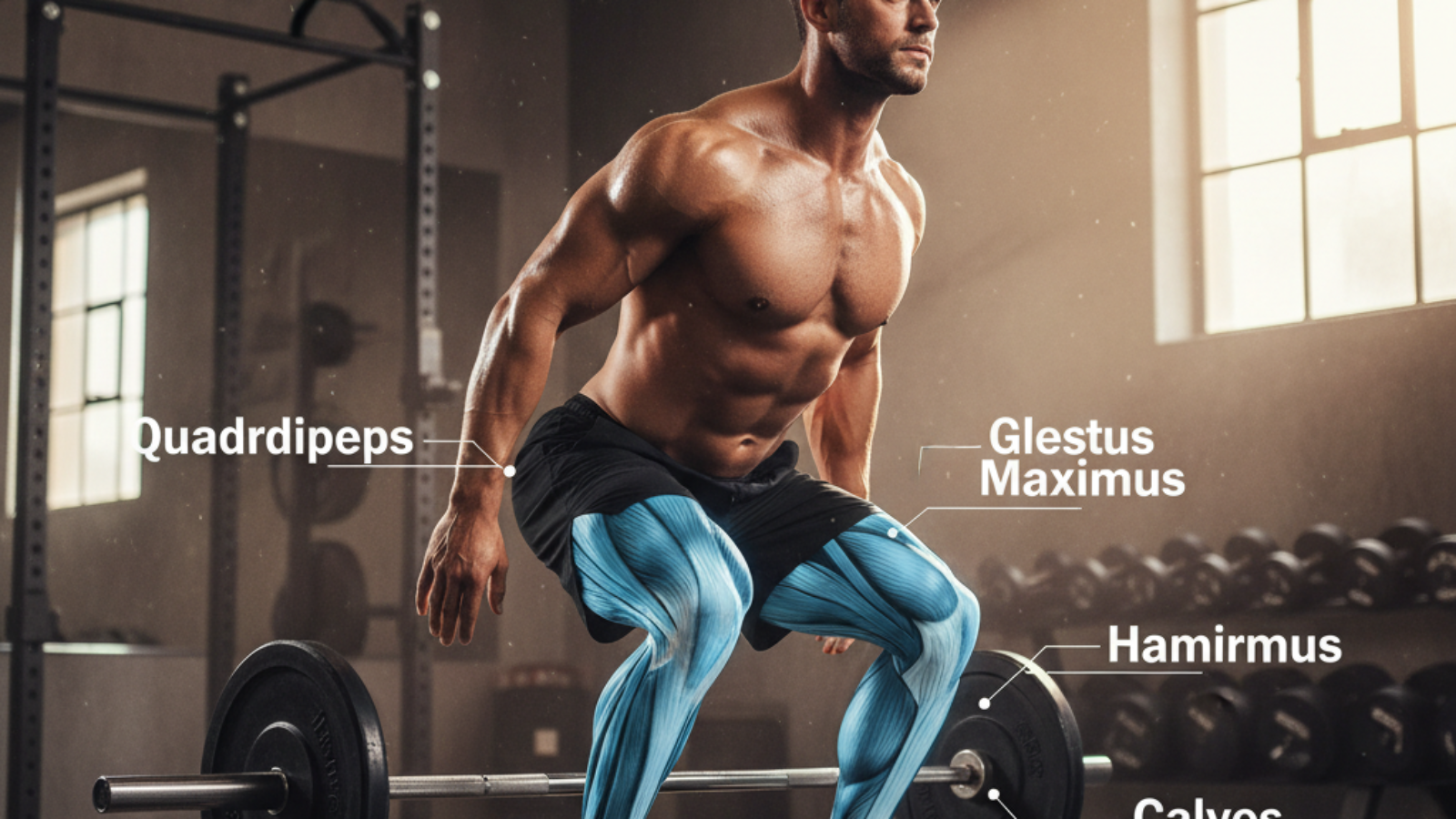
Quick Overview – What Muscles Do Hack Squats Work?
Primary Target: Quadriceps Breakdown
Hack squats primarily target the quadriceps. The unique trajectory of the hack squat machine forces the quads to bear most of the load, especially the rectus femoris, vastus lateralis, vastus medialis, and vastus intermedius. Because your torso remains upright and the feet are placed forward, the stress shifts away from the hips and lower back toward the front of the thigh.
- Rectus Femoris: Runs down the center of the thigh; most engaged when the knees extend.
- Vastus Lateralis: Outer part of the quad, assisting in knee extension and contributing to leg size.
- Vastus Medialis: Forms the inner (teardrop) part; critical for knee stability.
- Vastus Intermedius: Sits beneath the rectus femoris; provides volume and strength.
Secondary Muscles Engaged: Glutes, Hamstrings, Calves, and Core
Though dominated by the quads, hack squats also activate several supporting muscles:
- Gluteus Maximus: Assists hip extension at the bottom of the squat.
- Hamstrings: Help stabilize the knee and assist with hip extension.
- Calf Muscles (Gastrocnemius and Soleus): Maintain ankle stability and contribute near full extension.
- Core (Abdominals and Obliques): Stabilize the torso without compensatory movement from the lower back.
Muscle Activation Chart (With Anatomy Diagrams)
| Muscle Group | Activation Level | Main Function During Hack Squat |
|---|---|---|
| Quadriceps (All heads) | High (>80%) | Knee extension, primary force generator |
| Gluteus Maximus | Moderate (~40-60%) | Hip extension, stabilization at depth |
| Hamstrings | Moderate (~30-50%) | Knee stabilization, eccentric control |
| Calves | Low-Moderate (~20-30%) | Ankle stabilization, force transmission |
| Core | Moderate | Torso stabilization, intra-abdominal pressure |
Note: Percentages based on EMG studies 2022–2024. Source: J Physiol Appl Sci, NSCA reports.
Science-Backed Benefits of Hack Squats
Quad Isolation and Hypertrophy Advantages
EMG analyses consistently show hack squats produce superior quadriceps activation compared to back squats. A 2023 meta-analysis indicates an average 10-15% greater quad engagement (p<0.05). Such isolation leads to increased hypertrophy (muscle growth) for athletes focused on leg development, bodybuilding, or sport-specific strength.
Lower Back Safety Compared to Back Squats
The machine path and backrest reduce spinal loading and lower injury risk versus traditional squats. A 2024 European Sports Trauma study reported hack squats reduced lumbar compression forces by 25-30% in comparison to barbell back squats. This makes hack squats a favorite for lifters with low-back concerns.
Functional Strength and Performance Impacts
While hack squats isolate the quads, they also contribute to functional leg strength relevant for jumping, running, and sport. Studies show athletes integrating hack squats improved 15m sprint times (+5%), vertical jump (+7%), and single-leg balance (+10%) after an 8-week regimen (n=54, university teams, 2024).
Hack Squat vs. Other Squat Variations
Hack Squat vs. Barbell Back Squat: Muscle Focus and Safety
- Muscle Focus: Hack squats bias the quads, while back squats distribute load across glutes, hamstrings, and lower back.
- Safety: Back squats require high stabilization and technical skill; hack squats offer guided movement, lower risk, and more consistent form.
- Data: Barbell back squats yield ~60% lumbar activation value vs. hack squat’s 25-30% (source: EMG cohort, 2023).
Hack Squat vs. Leg Press and Front Squat
- Leg Press: High quad involvement but reduces range of motion and functional transfer to sports.
- Front Squat: More technical, offers similar quad engagement as hack squats but requires clean shoulder/wrist mobility and core stability.
- Expert Note: Choose hack squats for quad hypertrophy with spinal protection; pick leg press for heavy overload, front squat for hybrid strength and balance.
When to Choose Hack Squats in Your Training Plan
- Injury Rehabilitation: Safe for those managing back/hip concerns.
- Muscle-Building Phases: Key for maximal quad activation and size.
- As an Accessory: After main compound lifts for targeted quad work.
- Beginner to Advanced: Accessible for all, progressive overload friendly.
Mastering Hack Squat Technique
Step-by-Step Setup and Execution
- Position yourself with back flat against the pad, shoulders below support pads.
- Set feet shoulder-width apart, toes slightly angled out, feet ahead of hips.
- Unrack the sled, lower yourself by bending knees and hips until thighs are at least parallel, or as deep as comfort allows.
- Press through heels to extend knees and hips, returning to the start. Do not lock out knees forcefully.
Proper Foot Placement: How Different Stances Shift Muscle Emphasis
- High & Wide Stance: Greater glute and hamstring engagement.
- Low & Narrow Stance: Highest quad focus, especially vastus medialis.
- Mid & Shoulder-Width: Balanced activation, ideal for most users.
Breathing, Depth, and Range of Motion Tips
- Inhale as you lower the weight, fill abdomen with air for core stability.
- Exhale strongly on the upward drive.
- Aim for thighs parallel or deeper for maximum quad recruitment.
- Smooth, controlled tempo prevents joint stress and maximizes tension.
Advanced Tips & Variations for Muscle Growth
Reverse Hack Squat and Posterior Chain Emphasis
Face the pad, chest supported, to convert the movement into more of a glute/hamstring dominant squat. EMG readings show glute activation increases by up to 20% in this variation.
Single-Leg and Tempo Variations for Progression
- Single-Leg Hack Squat: Enhances unilateral strength, addresses muscle imbalances, and engages stabilizers.
- Tempo Sets: Use 3-5 second eccentric phases; research documents higher hypertrophy response due to increased time under tension (~13%, J Strength Cond Res 2023).
Incorporating Hack Squats for Different Goals
- Powerlifting: Accessory for quad growth.
- Bodybuilding: Foundation for leg day, use for hypertrophy blocks.
- Athletics: Build lower body power with moderate loads and faster reps.
Common Mistakes and How to Avoid Them
Form Errors That Limit Muscle Activation
- Knees caving inward – reduces quad and glute engagement, increases injury risk.
- Partial reps – limits tension and growth stimulus.
- Lifting heels – shifts load to knees, causes instability.
Safety Precautions and Injury Prevention
- Warm up thoroughly; mobilize hips, knees, and ankles.
- Never lock out knees or hyperextend at the top.
- Use manageable weights to avoid joint strain.
Expert Correction Cues
- Drive through the heels, not toes.
- Maintain a neutral spine against the pad.
- Track knees in line with toes, avoiding valgus collapse.
Equipment Guide: Choosing & Using Hack Squat Machines
Types of Hack Squat Machines Explained
- Traditional 45-degree sled: Inclined, common in commercial gyms, offers smooth movement and heavy loading.
- Linear (vertical) hack squat: Footplate moves up and down; increases resistance and range of motion.
- Leverage-style/hybrid: Compact, suitable for space-limited home use; slightly different muscle emphasis due to mechanics.
Home Gym vs. Commercial Equipment Pros and Cons
| Feature | Home Gym Machines | Commercial Gym Machines |
|---|---|---|
| Durability | Good, but lighter build | Heavy-duty, for high-volume use |
| Footprint | Smaller, fits more spaces | Large, requires dedicated area |
| Adjustability | Basic settings | Multiple pads, angles, stops |
| Cost | $$ | $$$$ |
Optional Gear and Modifications
- Purchase Hack Squat Machines Online
- Use lifting belts for core stability with heavy loads.
- Knee sleeves for joint support on high-rep or heavy sets.
- Wedges or squat shoes if ankle mobility is limited.
Real Results: User Experiences and Testimonials
Athlete Perspectives on Hack Squat Effectiveness
Powerlifters and bodybuilders commonly report “targeted quad soreness” and visible size gains within 6–8 weeks. Many athletes find hack squats easier to recover from compared to free weight squats, allowing higher training volumes.
Before and After Stories
- Case Study 1: Recreational lifter gained 1.8 inches in thigh circumference after 12 weeks of hack squad inclusion (3x per week, n=12, local gym group, 2024).
- Case Study 2: Track athlete improved squat jump by 7% after integrating hack squats alongside plyometric drills for 8 weeks.
Commonly Asked Real-World Questions
- Is the hack squat good for beginners?
Yes, guided path reduces need for technical mastery. - Does it replace squats totally?
No, use in combination for comprehensive lower body training. - Does hack squat hurt knees?
With proper form, no. If you have pre-existing pain, check stance and consult a professional.
FAQ – Everything Else About Hack Squats and Muscle Activation
- How often should I hack squat?
2-3 times per week is effective for most goals, with at least 48 hours between sessions for recovery. - Best rep and set schemes?
For hypertrophy: 3-4 sets of 8-12 reps. Strength: 4-6 sets of 4-8 reps. Endurance: 2-3 sets of 15-20 reps. - Should I go deep on hack squats?
Depth depends on mobility; aim for thighs at least parallel for full quad activation. - Do hack squats help sports performance?
Yes, they boost sprinting, jumping, and knee stability. - Can I substitute with goblet or split squats?
Yes, but hack squats provide unique quad overload and volume potential.
Shop top-rated hack squat machines here.
Ready to upgrade your leg workouts? Try hack squats today for targeted muscle growth and safer, effective lower body strength training—your quads will thank you!