How To Strengthen Ankles
A practical step-by-step guide to how to strengthen ankles, including preparation, instructions, common issues, tips, and next steps.
How To Strengthen Ankles
Strong ankles are the foundation for almost every movement, from walking on uneven ground to playing sports. Weak or unstable ankles can lead to painful sprains and chronic issues. This guide provides a clear, step-by-step routine to build strength, improve mobility, and enhance balance in your ankles. Whether you are recovering from an injury (with a doctor's approval), looking to prevent one, or simply want to improve your stability and athletic performance, these exercises will help you build a more resilient foundation from the ground up.
Fast Answer
- Key Action: Perform targeted exercises consistently.
- Frequency: Aim for 3-5 sessions per week.
- Focus On: A mix of mobility, balance, and resistance training.
- Result: Improved stability and reduced risk of injury.
Before You Start
Proper preparation ensures you perform the exercises safely and effectively. You don’t need much equipment to get started, but having a few optional items can help you progress. Most importantly, listen to your body and start slowly.
- A Clear, Flat Space: You need enough room to move your legs freely without bumping into furniture.
- Comfortable Clothing: Wear clothes that don't restrict your movement.
- A Sturdy Chair or Wall: Use this for support during balance exercises, especially when you are just beginning.
- Optional: Resistance Band: A simple therapy band is an excellent tool for adding resistance and targeting specific muscles.
- Optional: Cushion or Balance Pad: As you advance, performing exercises on an unstable surface will further challenge and strengthen your ankles.
Step-by-Step Instructions
Follow these exercises in order to create a complete ankle-strengthening routine. Focus on slow, controlled movements rather than speed. Quality over quantity is key.
Warm Up with Ankle Circles
A warm-up is essential to increase blood flow to the muscles and ligaments around the ankle, preparing them for exercise and reducing the risk of strain. Ankle circles are a perfect, gentle start.
- Sit on a chair with your feet flat on the floor, or stand tall, using a wall for balance if needed.
- Lift one foot slightly off the floor.
- Slowly rotate your ankle in a large circular motion, as if you are drawing a circle with your big toe.
- Perform 15-20 circles in a clockwise direction.
- Reverse the movement and perform another 15-20 circles in an anti-clockwise direction.
- Switch legs and repeat the entire sequence.
Improve Mobility with the Alphabet Exercise
This classic physiotherapy exercise helps improve your ankle's range of motion in all directions. It’s more complex than simple circles and engages more of the small stabilising muscles.
- Sit in a comfortable position where your foot can move freely without touching the floor. Extend one leg out in front of you.
- Imagine your big toe is a pen.
- "Write" each letter of the alphabet in the air using your ankle and foot. Try to write the letters in capital form to maximise the range of motion.
- Move slowly and deliberately through the entire alphabet from A to Z.
- Once completed, switch to the other foot and repeat.
You should feel the muscles all around your ankle and shin working. If it feels too easy, try making the letters larger.
Build Foundational Strength with Heel Raises
Heel raises, also known as calf raises, are fundamental for strengthening the calf muscles (gastrocnemius and soleus). These powerful muscles are the primary movers for pushing off the ground and play a massive role in ankle stability.
- Stand with your feet hip-width apart, near a wall or the back of a sturdy chair for balance.
- Keeping your back straight, slowly push through the balls of your feet to raise your heels off the floor as high as you comfortably can.
- Hold the top position for a count of one to two seconds, feeling the contraction in your calf muscles.
- Slowly lower your heels back to the floor in a controlled manner. Do not let them drop.
- Aim for 2-3 sets of 15-20 repetitions.
Strengthen Shin Muscles with Toe Raises
The muscle on the front of your shin, the tibialis anterior, is responsible for pulling your foot upwards. It’s the antagonist to your calf muscles and is crucial for controlling your foot when it lands during walking or running, helping to prevent foot slap.
- Stand with your back against a wall for support, with your heels about a foot away from the wall.
- Keep your legs straight and your heels planted on the floor.
- Slowly lift the toes and front part of your feet off the ground, pulling them up towards your shins as far as you can.
- Hold for a moment at the peak of the movement. You should feel a strong contraction in your shin muscles.
- Lower your feet back down with control.
- Aim for 2-3 sets of 15-20 repetitions.
Introduce Resistance with Band Exercises
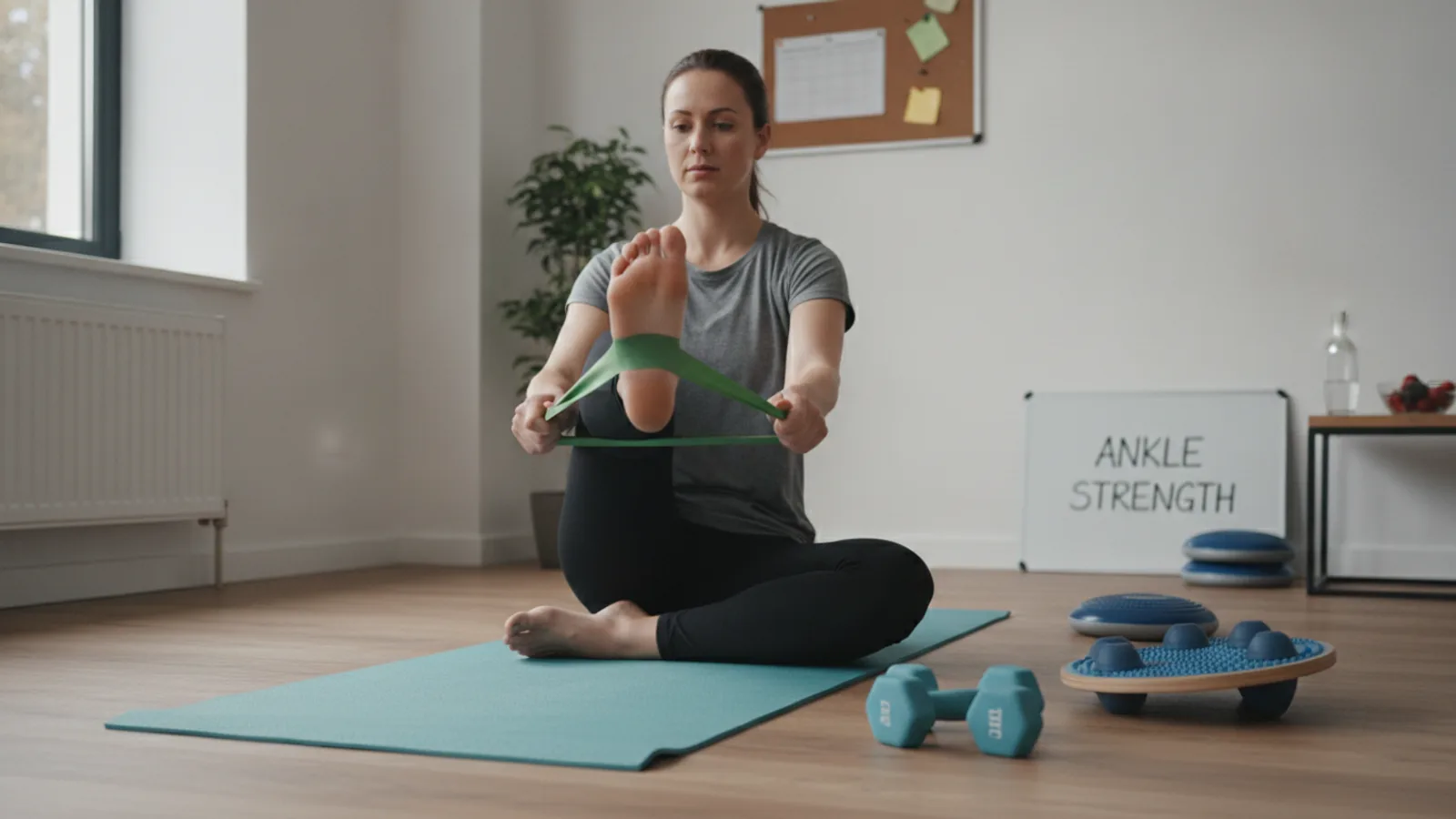
Resistance bands are an excellent way to target the specific muscles responsible for side-to-side and rotational stability of the ankle. Use a light-to-medium resistance band. The goal is controlled movement, not heavy lifting.
Plantar Flexion (Pointing Toes)
- Sit on the floor with your legs straight out in front of you.
- Loop the band around the ball of one foot, holding the ends of the band with both hands.
- Gently pull the band towards you to create tension.
- Slowly point your toes away from you against the band's resistance, like pressing a car's accelerator pedal.
- Return to the starting position with control. Perform 15 repetitions.
Dorsiflexion (Flexing Toes)
- Stay seated. Anchor the band to a sturdy object like a table leg.
- Loop the other end of the band over the top of your foot.
- Start with your foot pointed slightly forward, so there's tension in the band.
- Slowly pull your toes back towards your shin against the resistance.
- Return to the start with control. Perform 15 repetitions.
Inversion and Eversion (Side-to-Side)
- For inversion (turning the sole of the foot inward), anchor the band to the side. If working your right foot, anchor the band to your left. Loop it around the top of your right foot. Pull your foot inwards against the resistance for 15 reps.
- For eversion (turning the sole of the foot outward), anchor the band to the opposite side. If working your right foot, anchor the band to your right. Loop it around the top of your right foot. Push your foot outwards against the resistance for 15 reps.
- Repeat all four band exercises on the other leg.
Challenge Your Balance with Single-Leg Stances
Balance is a skill called proprioception—your body's ability to sense its position in space. Strengthening this skill trains the nerves and muscles around your ankle to react quickly to uneven surfaces, preventing rolls and sprains.
- Stand near a wall or chair for support.
- Shift your weight onto one leg and lift the other foot a few inches off the ground.
- Focus on keeping your standing ankle stable. Try to avoid wobbling. Look at a fixed point in front of you to help maintain balance.
- Hold this position for 30 seconds. If you feel very unstable, start with 10-15 seconds and build up.
- Switch legs and repeat. Aim for 2-3 sets per leg.
Cool Down with Gentle Stretches
After your workout, it's important to cool down and stretch the muscles you've just worked. This can help improve flexibility and reduce post-exercise soreness.
Gastrocnemius (Upper Calf) Stretch
- Stand facing a wall with your hands on it for support.
- Step one foot back, keeping that leg straight and the heel flat on the floor.
- Bend your front knee until you feel a gentle stretch in the calf of your back leg.
- Hold the stretch for 30 seconds. Do not bounce.
- Switch legs and repeat.
Soleus (Lower Calf) Stretch
- Get into the same starting position as the stretch above.
- This time, slightly bend the knee of your back leg while keeping your heel on the floor.
- You should feel the stretch lower down in your calf, closer to the Achilles tendon.
- Hold for 30 seconds, then switch legs.
Quick Reference
| Situation | Use this | Why |
|---|---|---|
| My ankles feel stiff in the morning. | Ankle Circles & Alphabet Exercise | Gently moves the joint through its full range of motion, improving mobility and circulation without load. |
| I feel wobbly on uneven ground. | Single-Leg Stances | Directly trains proprioception, improving the reaction time of the stabilising muscles around the ankle. |
| My feet get tired quickly when running or walking. | Heel Raises & Resistance Band Exercises | Builds muscular endurance in the primary movers (calves) and supporters (inversion/eversion muscles). |
| I want to prevent a recurring ankle sprain. | All exercises, especially Band & Balance work | Creates a comprehensive support system by strengthening all supporting muscles and improving reactive stability. |
Common Problems When You Strengthen Ankles
As you begin your strengthening journey, you might encounter a few common issues. Here’s how to address them safely.
Feeling Pain During Exercises
It's important to distinguish between the dull ache of muscle fatigue and a sharp, stabbing, or pinching pain. Muscle fatigue is normal, but sharp pain is not. If you feel sharp pain, stop the exercise immediately. Try performing it with a smaller range of motion or less resistance. If the pain persists, it’s best to rest and consult a healthcare professional. Pushing through pain can lead to a more serious injury.
Lack of Noticeable Progress
Strength and stability build over time, not overnight. If you feel like you've hit a plateau after a few weeks, don't get discouraged. First, check your consistency. Are you doing the exercises regularly? If so, it might be time to progress. You can increase the challenge by:
- Adding more repetitions or an extra set.
- Using a stronger resistance band.
- Holding balance poses for longer.
- Performing balance exercises on an unstable surface.
Clicking or Popping Sounds
Occasional, painless clicking or popping (known as crepitus) in the ankle joint can be normal. It's often just the sound of tendons moving over bone or gas being released from the joint fluid. However, if the clicking is accompanied by pain, swelling, or a feeling of the joint locking up, it could indicate an underlying issue. In this case, you should seek medical advice.
Advanced Tips for Strengthening Ankles
Once you’ve mastered the basics and built a solid foundation of strength and stability, you can incorporate more advanced techniques to further challenge your ankles.
Incorporate Plyometrics
Plyometrics are jumping exercises that build explosive power and teach your ankles to absorb impact safely. Start simple. Practise jumping up and down on the spot, focusing on landing softly and quietly on the balls of your feet, with your knees bent. Progress to small box jumps or skipping with a rope. Only attempt these exercises once you are pain-free and confident in your ankle strength.
Use Unstable Surfaces Regularly
Make balance training more dynamic. Using tools like a wobble board, BOSU ball, or a simple balance cushion forces the stabiliser muscles in your ankles and lower legs to work constantly. You can perform single-leg stances or even bodyweight squats on these surfaces to significantly enhance your proprioception and stability.
Integrate into Everyday Activities
Look for opportunities to challenge your ankles throughout the day. Stand on one leg while you brush your teeth. Walk on the balls of your feet for a minute. When you take the stairs, perform a slow, controlled heel raise on each step. These small, consistent efforts add up over time and reinforce the strength you build during your dedicated sessions.
How To Strengthen Ankles FAQ
How often should I do these ankle exercises?
For best results, aim to perform this routine 3 to 5 times per week. Your muscles need time to recover and rebuild, so it's good to have at least one or two rest days. Consistency is more important than intensity, especially at the beginning.
How long will it take to notice a difference?
While everyone's body is different, you may start to feel a subtle improvement in stability and confidence in as little as 2 to 4 weeks of consistent practise. More significant gains in strength and resilience typically become noticeable after 6 to 8 weeks.
Can I do these exercises if I have flat feet?
Yes, in many cases, strengthening the muscles that support the ankle and foot arch can be beneficial for individuals with flat feet. However, it's crucial to focus on maintaining proper form. If you have significant foot-related issues, consulting with a podiatrist or physiotherapist for personalised advice is highly recommended.
Are ankle weights a good idea for these exercises?
For most of these specific mobility and stability exercises, resistance bands are a better and safer choice than ankle weights. Bands provide resistance through a specific range of motion, targeting the intended muscles. Ankle weights, on the other hand, can place undue stress on the ligaments and joint capsule, especially during dynamic movements.
Should I wear an ankle brace while exercising?
An ankle brace provides external support, which can be necessary during recovery from a significant injury. However, the goal of these exercises is to build your body's internal support system. Unless specifically advised by a doctor for your condition, it is best to perform these strengthening exercises without a brace to ensure your muscles are doing the work.
Final Checklist for Strengthening Ankles
Use this checklist to ensure you're approaching your ankle strengthening routine in a safe and effective way.
- Get Clearance: If you have a history of serious injury or chronic pain, consult a healthcare professional before you start.
- Always Warm Up: Begin every session with gentle mobility exercises like ankle circles.
- Focus on Form: Prioritise slow, controlled movements over speed or high repetitions.
- Listen to Your Body: Stop immediately if you feel any sharp or unusual pain.
- Be Comprehensive: Include a mix of mobility (circles), strength (raises, bands), and balance (stances) exercises in your routine.
- Stay Consistent: Aim for 3-5 sessions per week for the best long-term results.
- Cool Down: Finish each session with gentle stretches for your calf muscles.
- Progress Gradually: Only increase the difficulty when you can comfortably complete the current exercises with good form.