
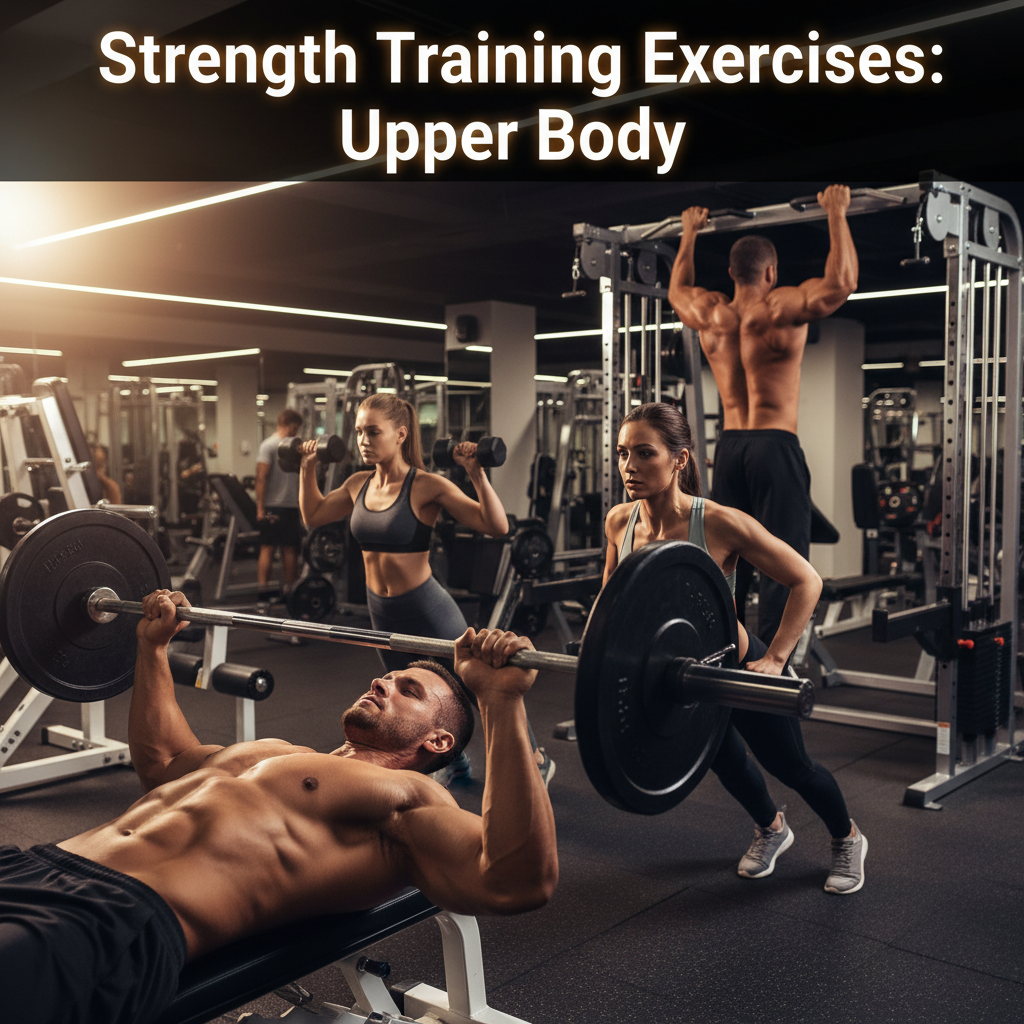
Diverse people perform upper body strength exercises in a modern gym under dynamic, motivating lighting.

Strength Training Exercises Upper Body: 10 Best Workouts for 2026

Why Upper Body Strength Training Matters in 2026

Health and Fitness Benefits of Upper Body Strength Training

Upper body strength training helps you build muscle, lose fat, and improve daily activities. Strong upper body muscles protect your joints and bones, support good posture, and make you less likely to get hurt. In 2026, most health experts recommend strength training for people of all ages, including teenagers. Training your upper body also makes you better at sports, improves your confidence, and boosts your metabolism.

Common Myths and Mistakes to Avoid

  • Myth: Strength training will make you bulky. Truth: Most people gain lean muscle, not bulk, and look more toned.
  • Myth: You need lots of equipment. Truth: Many effective exercises use only your body weight or simple dumbbells.
  • Mistake: Skipping warm-ups or using poor form can cause injury. Always use proper technique and warm up first.

Upper Body Anatomy and Key Muscle Groups for Strength

Primary Muscles Targeted by Strength Training Exercises

  • Chest (Pectorals)
  • Back (Latissimus dorsi, Rhomboids, Trapezius)
  • Shoulders (Deltoids)
  • Arms (Biceps, Triceps, Forearms)
  • Core (Abdominals and Obliques)

How Strength Training Improves Posture and Performance

Strong upper body muscles help you stand taller and move better. Good posture reduces back pain and helps you breathe easier. Building these muscles also increases your strength for other activities like running, swimming, and carrying backpacks.

Essential Strength Training Exercises for Upper Body

Push Movements (Chest, Shoulders, Triceps)

How to Do the Push-Up Properly (with Modifications for All Levels)

  1. Start in a plank position, hands shoulder-width apart, body in a straight line.
  2. Lower your chest to the floor by bending your elbows.
  3. Push back up to the starting position.
  4. Beginner: Drop your knees to the floor for knee push-ups.
  5. Advanced: Elevate feet or try diamond push-ups for harder variations.

Dumbbell Bench Press: Step-by-Step Guide

  1. Lie flat on a bench, holding a dumbbell in each hand above your chest.
  2. Lower dumbbells slowly until your elbows are at 90 degrees.
  3. Press the weights back up until your arms are straight.

Overhead Press for Shoulder Strength

  1. Stand with feet shoulder-width apart, holding dumbbells at shoulder height.
  2. Push the weights upwards until your arms are fully extended.
  3. Lower the weights back to your shoulders with control.

Pull Movements (Back, Biceps)

Correct Form for Pull-Ups (Progressions & Regressions)

  1. Hang from a pull-up bar with your palms facing away.
  2. Pull your chin above the bar, keeping your body straight.
  3. Lower slowly to the starting position.
  4. Beginner: Use resistance bands or an assisted pull-up machine.
  5. Advanced: Try wide grip or weighted pull-ups for more challenge.

Seated Row: Targeting the Upper Back Safely

  1. Sit on a row machine, feet on the platform, holding the handle with both hands.
  2. Pull the handle toward your abdomen, squeezing your shoulder blades together.
  3. Slowly extend your arms back to the starting position.

Lat Pulldown Best Practices

  1. Sit at a lat pulldown machine and grip the bar wider than your shoulders.
  2. Pull the bar down in front of you to your upper chest.
  3. Let it return slowly while keeping shoulders down.

Functional and Core Support Exercises

Plank Variations for Core Stability

  1. Standard plank: Forearms on ground, body straight from head to heels.
  2. Side plank: Support your body on one forearm and the side of your foot.
  3. Challenge: Lift alternate arms or legs for advanced stability.

Face Pulls to Prevent Shoulder Injuries

  1. Attach a rope to a high pulley on a cable machine.
  2. Pull the rope to your face, keeping your elbows high and squeezing your shoulder blades together.
  3. Control the movement as you return to start.

Sample Upper Body Strength Training Routine (2026)

Full Routine Table: Sets, Reps, and Rest (Beginner, Intermediate, Advanced)

Exercise Beginner Intermediate Advanced
Push-Up 3×8 4×10 5×15
Dumbbell Bench Press 3×8 4×10 5×12
Overhead Press 3×8 4×10 5×12
Pull-Up 3×5 (assisted) 4×8 5×12
Seated Row 3×10 4×10 5×12
Lat Pulldown 3×10 4×10 5×12
Plank 3x20s 3x40s 3x60s
Face Pull 3×12 4×15 5×15

Weekly Progression Tips for Strength Gains

  • Add 1-2 extra reps each week if the exercises feel easy.
  • Increase weight in small amounts (e.g., 1-2 kg) when you can complete all sets easily.
  • Keep rest time between sets to 1-2 minutes for good results.

Interactive Checklist: Track Your Upper Body Workouts

  • Record each session: date, sets, reps, weight used.
  • Check off each exercise as you complete it.
  • Note how you felt and any challenges during workouts.

Form Corrections and Technique Tips

Common Errors and How to Fix Them (Videos & Diagrams)

  • Pushing hips up during push-ups—keep your body straight.
  • Letting elbows flare too much on bench press—keep them at about 45 degrees.
  • Using momentum to swing during rows—move smoothly with control.

Evidence-Based Cues for Injury Prevention

  • Keep your core tight for all movements.
  • Move slowly and avoid jerking motions.
  • Breathe out during exertion, breathe in on return.

Adapting Exercises for Home or Gym Equipment

  • Use water bottles, resistance bands, or backpacks if you don’t have dumbbells.
  • Do push-ups on a stable chair or table edge at home.
  • For rows, use bands around a closed door or a bench at the gym.

Recovery, Mobility, and Active Rest for Upper Body Training

Warm-Up and Cool-Down Essential Movements

  • Arm circles, shoulder shrugs, and light cardio before starting.
  • Gentle stretching and breathing exercises after workouts.

Stretching and Mobility for Shoulder and Back Health

  • Cross-body shoulder stretch: hold each arm across your chest.
  • Child’s pose and cat-cow stretches for your back.
  • Foam rolling helps relax your muscles and reduce soreness.

How Often Should You Train Upper Body? (Expert Insights)

  • 2–3 times per week for most people.
  • Rest at least 48 hours between sessions for recovery.
  • Always listen to your body—skip training if you feel pain or extreme soreness.

Variations and Progressions for Every Fitness Level

Adapting Exercises from Beginner to Advanced

  • Start with bodyweight, move to dumbbells or resistance bands as you get stronger.
  • Add more challenging versions (decline push-up, one-arm row, or plyometric movements).
  • Lower rest time or do more reps for endurance.

Supersets, Tempos, and Resistance Bands

  • Try supersets: do two exercises back to back without rest (e.g., push-ups and rows).
  • Change tempo: slow down the lowering phase for extra muscle work.
  • Use resistance bands to add intensity without heavy weights.

Programming for Different Goals (Strength, Muscle Gain, Endurance)

  • Strength: Fewer reps (4–8), more weight, longer rest (2–3 min).
  • Muscle gain: More reps (8–12), moderate weights, 1–2 min rest.
  • Endurance: High reps (12+), lighter weights or bands, short rest (30–60s).

Interactive Q&A: Upper Body Strength Training FAQ (2026)

Expert Answers to Common Training Challenges

  • Q: I can’t do a full push-up—what should I do? A: Try knee push-ups or use a wall to build strength.
  • Q: My progress is slow. A: Track your workouts, try new variations, and ensure proper nutrition.

Troubleshooting Plateaus and Motivation

  • Change your routine every 4–6 weeks.
  • Work out with a friend to stay motivated.
  • Set small, specific goals and celebrate progress.

Safety Tips for Special Populations (Older Adults, Beginners)

  • Start with simple movements and focus on form.
  • Avoid heavy weights at first if you have joint concerns.
  • Ask a coach or trainer if unsure about any exercise.

Summary: Key Points and Next Steps

  1. Upper body strength training provides health, posture, and performance benefits.
  2. Stick to correct form for best results and safety.
  3. Progress at your own pace, using more variations as you get stronger.
  4. Track your training and adjust when needed for continued gains.
  5. Make recovery and rest part of your routine for better outcomes.

Ready to get started? Choose 4–6 upper body strength training exercises, use this guide as your weekly plan, and watch your strength and confidence grow!

Tags: No tags

Add a Comment

Your email address will not be published. Required fields are marked *